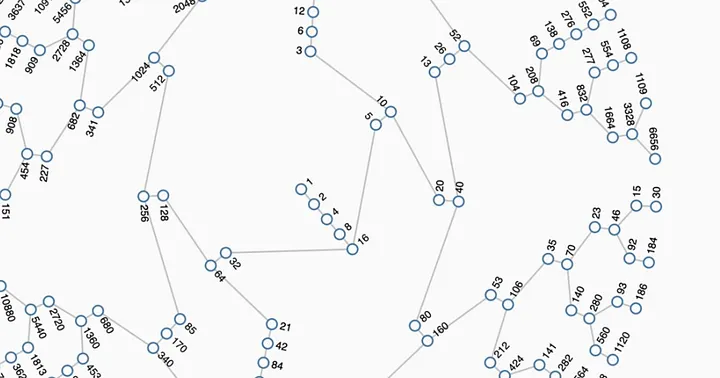
Collatz Conjecture, one of the most intriguing problems in the history of mathematics, remains unsolved to this day. In this article, a comprehensive analysis of the history, basic principles, current research, future directions, and advanced studies related to Collatz Conjecture will be presented.
Foundations of Collatz Conjecture:
Collatz Conjecture posits that for any positive integer, following a specific rule in each step of the Collatz sequence will eventually lead to the number 1. The basic rule of the sequence dictates that if the number is even, it is divided by 2, and if it is odd, it is multiplied by 3 and added by 1. This process is repeated until the number reaches 1.
History of Collatz Conjecture:
Collatz Conjecture was first introduced in 1937 by German mathematician Lothar Collatz. Despite its simplicity, the problem remains unsolved, garnering interest from both students and experts in the field of mathematics.
Current Research and Progress:
Numerous studies have been conducted to validate Collatz Conjecture, but a definitive solution has not yet been found. Mathematicians have employed various approaches and strategies to test the conjecture, yielding some results. However, a general method to prove whether any starting number will eventually reach 1 remains elusive.
Future Directions and Advanced Studies:
Future research avenues and methodologies towards solving Collatz Conjecture are still open. Mathematicians may leverage new technologies and mathematical techniques to develop novel approaches for proving the conjecture’s validity. However, the problem continues to stand as one of the greatest mysteries in the world of mathematics.
Conclusion:
Collatz Conjecture, an unsolved mathematical mystery, has intrigued mathematicians for decades. While extensive research has been conducted, a definitive solution remains elusive. Future studies are expected to play a crucial role in advancing our understanding of Collatz Conjecture and potentially solving this intriguing problem.
References:
1. Jeffrey C. Lagarias, “The 3x+1 problem: An Annotated Bibliography, II (2000–2009)”, arXiv:1001.3593
2. Eric Roosendaal, “Unbounded orbits in the Collatz problem”, arXiv:0804.1625
3. Terence Tao, “Structure and Randomness in the Collatz sequence”, arXiv:0910.3926